
The Oregon Mozart Players will present Gustave Mahler’s Das Lied von der Erde (The Song of the Earth) for the second time on February9, 2013. This work was written for a huge orchestra, not a chamber orchestra. Several years ago, a rich Hong Kong businessman paid for OMP’s former Artistic Director, Glen Cortese, to prepare an arrangement for Chamber Orchestra which allowed the songs to be sung for the first time ever in the original Mandarin. (Scholars have an approximate understanding of how the spoken language has changed in the last 1300 years.) This time OMP will go back to the traditional German translation with an arrangement for Chamber Orchestra chiefly due to Arnold Schoenberg. [I hope the computer screen you are using will support the Chinese characters (hanzi 漢字) I give for most of Chinese words.]
Gustave Mahler (1860 – 1911) composed Das Lied von der Erde in 1908/9 shortly after reading Hans Bethge’s (1876 – 1946) collection of Chinese poems titled Die chinesische Flöte (The Chinese Flute; published in the fall of 1907 with an astounding first printing of 100,000 copies). Mahler uses several of the poems from this collection with additions of his own. Each of the six movements is a superbly orchestrated poem. These poems gave him relief from the very difficult period of his life he had just gone through. Mahler and others considered this amazing work to be his most personal statement.
Because of my love of Chinese history and culture, I will give a brief but well annotated list of the sources of the poems Mahler used.
All the poets whose German language translations Mahler uses are from the Tang Dynasty 唐朝 (618 – 907). This dynasty is often considered the high point of Chinese culture. Its capital Chang’an 長安 (enduring peace) (essentially the modern city of Xian 西安 (western peace) (the character for peace 安 pronounced “an” shows a woman in a house) had over a million extremely cosmopolitan inhabitants, at a time when probably no European city had a population over 50,000. The area controlled by the empire was one of the largest of any centrally controlled state in world history. The short preceding Sui Dynasty and the Tang Dynasty were 500 to 1,000 years ahead of the rest of the world in engineering and scientific knowledge.
Four movements are based on poems by Li Bai 李白 (701 – 762; often called Li Bo in English): Das Trinklied vom Jammer der Erde, Von der Jugend, Von der Schönheit and Der Trunkene im Frühling. Li Bai is one of the greatest of the many famous Tang Dynasty poets. He collected folk songs and based many of his poems on them or on works of the earlier Han 漢朝 (206 BCE – 220 CE) or Sui 隋 (581-618) Dynasty poets. He gloried in his drunken life style. Almost every literate Chinese person from his time to the present has been able to recite some of his poetry. (The communist leader, Mao Zedong (1893 – 1976) could recite hundreds and used some as models for his own numerous but quite different poems.) The best known of the many stories about Li Bai is that he died when he fell out of his boat on the Yangtze River (in Chinese Long River, Chang Jiang 長江) while drunk trying to embrace the reflection of the moon. This (probably apocryphal) event is still widely commemorated.
China has many scenic places visited for 2,000 years or more and still thronged by tens of thousands of modern Chinese tourists. Li Bai travelled widely and if he wrote a poem when he visited, it is likely to be inscribed on multiple stele, buildings or rock faces at the site.
Here is a free English translation of the basis for Der Trunkene I’m Frühling.
處世若大夢, Life in the world is but a big dream;
胡爲勞其生. I will not spoil it by any labour or care.
所以終日醉, so saying, I was drunk all the day,
頹然臥前楹. lying helpless at the porch in front of my door.
覺來盼庭前, when I awoke, I blinked at the garden-lawn;
一鳥花間鳴. a lonely bird was singing amid the flowers.
借問此何時, I asked myself, had the day been wet or fine?
春風語流鶯. the Spring wind was telling the mango-bird.
感之欲嘆息, moved by its song I soon began to sigh,
對酒還自傾. and, as wine was there, I filled my own cup.
浩歌待明月, wildly singing I waited for the moon to rise;
曲盡已忘情. when my song was over, all my senses had gone.
Li Bai

Li Bai Chanting a Poem. Painting by Liang-Kai 梁楷; 1140-1210. (I have kept a reproduction of a similar painting by Liang K’ai in my office for over half a century.)
The movement Der Einsame im Herbst is based on a poem by Qian Qi 錢起 (710–782) who was another famous Tang Dynasty poet from Wu 吳 (now-a-days Zhejiang 浙江 (crooked river, old name for the Qiantang River 錢塘江) and Hubei 湖北 (south of the lake) provinces around the fairly new city of Shanghai and the beautiful ancient city of Hangzhou 杭州 with its picturesque West Lake 西湖 much further down the Yangtze. (The European name, Yangtze, of this river comes from a Song Dynasty 宋朝 (960 – 1279) poem by Wen Tianxiang 文天祥 (1236 – 1283). Early Christian missionaries learned this poem about a short stretch of the river near its mouth and mistakenly applied the name to the whole river. This is another illustration of the enduring influence of ancient poetry in China. Since I am also fond of genealogy, I cannot refrain from mentioning that Wen Tianxiang’s traditional genealogy extends over 4,500 years.
Wen Tian-xiang Duke of Xinguo 

Bust of Wen Tianxiang in his temple in Beijing.
Born 6 June 1236 Died 9 January 1283 (aged 46)
Der Abschied combines poems by Mong Haoran 孟浩然 (690 – 740) and Wang Wei 王維 (699 -759), plus several additional lines by Mahler himself.
Meng Haoran is another Tang poet from Hubei 湖北 (north of the lake) whose early nature poetry has remained famous up to the present. He and Wang Wei were friends and both wrote poems about their friendship. A painting of Meng Haoran 
Wang Wei, is famous not only for his nature poetry but also for music, painting and calligraphy. He was from an ancient aristocratic family and became well known when he moved to Chang-an from his birthplace in Shanxi Province 山西 (mountain west) while still very young. Later in life he became a historically important administrator and finally a Chan Budhist recluse. His official career saw many ups and downs, but he lived most of his life in Chang-an.
The most important political event in the Tang Dynasty was the An Lushan rebellion 安史之亂 (An Shi Zhiluan; 755 -763, with connections to political upheavals all over central Asia) when the Tang Emperor Xuanzong 唐玄宗 had to escape to Shu (modern Sichuan 四川, four rivers). During this famously difficult journey, the Emperor’s beloved concubine Yang Guifei 楊貴妃, whose intrigues had helped An Lushan, was executed. This is one of the best known incidents in Chinese history, commemorated in many painting, poems and stories.
When An Lushan triumphed, Wang Wei was ill and could not escape Chang-an so he became the most important government official captured by the rebels. They abducted him and tried hard to enlist his aid but he resisted with considerable difficulty, about which there are various stories.
Modern Statue of Wang Wei

*I meant this to be the third 1955 mining story right after my discussion of the geology of the area, but posted the fourth story first by mistake. TWP*
Exploration Incorporate, the company for which I worked in the summer of 1955, was trying to learn how much uranium was in the Shinarump Formation around the Four Aces mine in the White Canyon Desert of southeast Utah. This mine like the Happy Jack mine about 7 miles away in the same formation had been opened in 1893 for the rich copper deposit in the discontinuous Shinarump Formation, but the cost of transportation (by mule train down to Hite on the Colorado River, by boat down river and then by mule train up to a smelter) was too high for profitability even with very high grade ore. After 1946 when the USA government said it would buy any ore over 0.10% U_2O_3, the Happy Jack Mine soon started shipping millions of dollars worth of such ore. (I have explained the fascinating geology in a previoust essay, but here I should reiterate that the Shinarump formation was a conglomerate fill of ancient meandering river beds.)
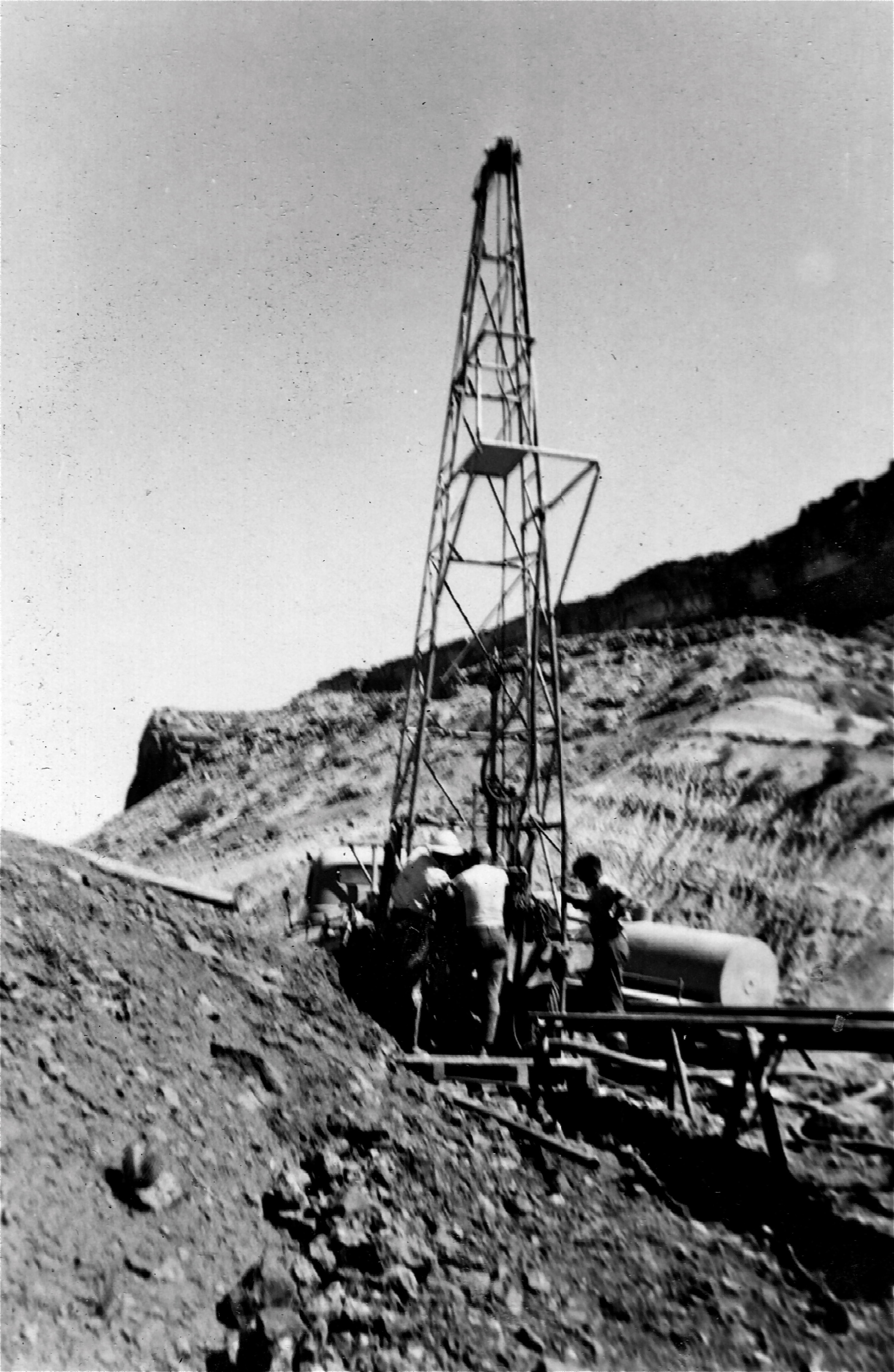
A drilling rig at Four Aces Claim in August 1955 with the sloping Chinle shale mostly hiding the tall Wingate cliffs of Copper Point. (Most crews had one driller often in his 20s and two teenage kids. The latter often liked to shoot at the common, tiny (6 to 10 inches long and under 1/2 inch diameter) sidewinders. Since we all wore boots this shooting was much more dangerous (bullets fly off rocks in surprising directions) than the snakes themselves. They are only dangerous when you sleep on the ground. They may slide into your sleeping bag to escape the cold desert nights and if you role over a bite in the wrong place could easily be fatal.
Most of the summer there were two of us living in the Four Aces tunnel and supervising hired drilling crews from other small companies. We were trying to follow the Shinarump ancient river channel as it meandered under the sloping, and thus increasingly thick Shinle shale.
This story related to one night late in the summer when I was the only company man on duty. At the time, one drilling company was working for us 24 hours a day with three crews. They charged us per foot of drilling in the Chinle, and a lot more per foot of core drilling when they hit the Shinarump. They also charged $100 per hour if they had to wait for us to tell them where to drill next. (That does not sound like much today, but it was a lot of money in 1955.)
The upper portion of the Chinle was unstable so they cased the top of each drill hole with 80 feet of steel casing. After each hole was finished I lowered a sensitive scintillation counter on a measured cable to count the radiation every foot from top to bottom. Then they pulled their only two 40 foot lengths of casing (so the drill hole usually caved in) and went on to the next spot. Assuming the hole hit the light gray uranium and copper bearing Shinarump rather than going directly into the underlying purple very fine grained Moenkopi sandstone, the next drill hole was straight forward. If the hole missed, we had to guess whether the ancient river channel had turned right or left. (We were going upstream .)
That night the drilling crew guessed they would finish a 250 foot deep hole about 3:00 am so I bedded down next to the drill site. When they had pulled most of the drill stem they waked me up so I could calibrate the scintillation counter. It would not turn on! Inspection showed that a solder joint between the counter itself and the 500 foot cable had broken. Because the drilling company had only a single string of casing pipe they could not move until I had measured the radiation.
At Fry Canyon about five miles away there was a tiny settlement and I felt pretty sure that when people there woke up, there would be someone able to re-solder the joint. If not, it was more than a three hour drive to the nearest town, Blanding, Utah. Thus the drilling company would charge my company a minimum of $500 to possibly well over $1,000.
I remembered seeing a discard lead-acid car battery on the side of the road only a few miles away. I convinced the drillers to take a 1.5 hour lunch break before beginning to charge down time. I sped off in my jeep to find the old battery. I was not sure my headlights would illuminate it in the dark, but they did. I chopped it open, took out a few lead plates and drove back up the tricky back-up switchback on the Moenkopi cliffs to the Four Aces tunnel. I melted the lead in an old tuna fish can on our propane stove. Solder is a mixture of about 60% tin and 40% lead with a melting point around 185 degrees whereas pure lead melts at 327 degrees. Even with solder one usually needs flux to make a joint. I had already thought of this. Our old tunnel had been re-timbered with pine logs. Where they were bruised oily sap had accumulated which made an excellent flux. Because of the high temperature of the melted lead, it took several attempts to make a good solder joint.
However, within 1.5 hours I had counted the radioactivity of the hole, the drilling company had pulled their casing and moved on to the next drill site without charging my company a penny for down time.
I went back to sleep feeling that I had earned the money I would charge for my night time work.
Human beings were evolved to be resourceful and deal with dozens of different kinds of challenges every day. For the past few thousand years more and more of us have been assigned to specialized expert jobs. We may face challenging and interesting problems, but they tend to be more and more the same kind day after day. Thus I found prospecting at least as satisfying as the many jobs I have had since then. If you know me, you know I have always managed to do several different kinds of work every day.
Both summers that I worked as a prospector we worked the “long week”: 11 days in the field followed by 3 days in town. I saved all my money, because many slightly older folks (i.e. in their 20s) worked the long week and then spent all they earned in the three day periods in town. They were generous, if not sensible, while drunk and well supplied with female companionship.
In White Canyon, usually two Exploration Incorporated men worked overlapping long weeks. While in town we bought food to last for the full time out in our home tunnel. We had little propane refrigerators which kept our steaks edible for about half a long week but we got used to scraping a bit of mold off them before cooking towards the end. (Bacon was practically immortal under our conditions.) We could refill our the jeeps’ 40 gallon tanks with potable water at Hite, down on the Colorado River (now way under Lake Powell) about 10 miles away.
Towards the end of one long week late in the summer we ran out of food early so I decided to drive 70 miles up to Blanding, Utah to buy some more. The desert is HOT during the day so I started out about 5:00 pm. I got about 2.5 miles past Fry Canyon when the jeep simply would not go any more. A pretty rudimentary inspection showed that an axle was broken. (I no longer remember which one.) It was not yet quite dark, but was already cooling off so I hiked back to Fry Canyon, found a mechanic, told him where my jeep was, and gave him the key upon his agreeing to tow the jeep back, weld the axle and get it going again. By then the temperature was pleasant and the sun had long since gone down. There must have been a moon because I do not remember any trouble seeing. I decided my best bet was to hike back the 18 miles to the Four Aces Claim along highway 95. I thought there was a good chance (say 30%) that someone would drive by and I knew they would give me a lift.

A recent picture of Fry Canyon Lodge built in 1955 and (as its web page notes) far (30 miles?) from any other building.
I had probably gone about 5 miles when I heard a vehicle coming up behind me. Of course it stopped when I put out my thumb. The beat-up pick-up truck held one old prospector. He was friendly and as soon as I said where I was headed he agreed to take me. I had already taken in that he was holding a fifth of something (rum, as it turned out). When I got in I was pleased to see that it was almost empty. I stressed that he only needed to take me to the bottom of the cliff.
Of course he offered me a drink. Figuring that the more I drank the less he would have, I took a pretty good pull in spite of the fact that I was not at all used to hard liquor. I was very disappointed when he drained the bottle and puled out a new full fifth.
Prospectors are very interested in what other prospectors are doing; that is a primary responsibility. When he asked I told him the preposterous tale that we were thinking of opening the Four Aces Mine for copper. (Lies are what prospectors tell each other.) Of course he knew I was lying but I was sure he would pretend to believe me so he could ask lots more questions. I had fun thinking up consistent but far-fetched answers. He was in a happy state and I think he was having fun also. We got to the bottom of the Moenkopi cliff. I opened the door before he stopped and said I would hike up, but of course he would not stop. So we went up the narrow road gouged into the cliff until the bumper stuck over the end with a 50 foot drop ahead. He had no trouble backing up the next narrow stretch stopped exactly in the right spot a few inches from the 120 foot drop, lurched forward up the next steep stretch and made the extremely sharp turn to get his truck up on top of the Moenkopi. We drove about a mile on the Chinle until we came to the end of the Four Aces tunnel. (When he got out I was interested to see that he could walk pretty well in spite of extreme inebriation. I had already admired and been relieved by his driving skills in this condition.) I had expected to see my buddy, but it turned out he had gone for a night time stroll. He had even padlocked the tunnel door. Naturally my drunken friend wanted to see the tunnel and it was easy to show him all sorts of copper ore, so I took him back all the way (about 225 feet).
Just then my buddy came back. He was not expecting me back until the next day. (There was a trailer in Blanding belonging to another prospecting outfit and they had told us how to find the key, since the trailer was usually empty.)
What did my buddy see? A strange pretty bad looking pickup where no one was likely to come on their own. A padlocked tunnel door unlocked and two men at the back of the tunnel. I held the lantern up to my face hoping he would recognize me but we were too faraway. I yelled, but if you have ever been in a mine tunnel you know that sound bounces off the floor, walls and roofs and cancels out in 20 or 30 feet. So my buddy quite naturally picked up one of the rifles we kept just inside the tunnel door and pointed in in our direction. Under the circumstances there was no need to aim at us because we were in a straight tunnel with no escape. Aiming would have been taken as bad manners whereas pointing the gun more or less in our direction was only to be expected.
Soon he recognized me. When we got close I briefly explained. We told the old guy a bunch more tall tales and he left after awhile. The next morning I went out early looking for a wreck, but he either got down during the night or did so before I came looking. I wonder whether he finished the second fifth?

The most spectacular feature on the trip from White Canyon to Blanding was Comb Ridge. Since I have no other pictures relevant to this story I will put in pictures of this amazing feature even though I did not get close to it on this trip. The first picture shows Utah Highway 95 crossing Comb Ridge in the middle distance (the prominent natural notch). Although the picture is modern, from this distance it would have looked the same in 1955.

- The next picture is about 25 miles of Comb Ridge from a high altitude airplane. It runs almost exactly north-south.
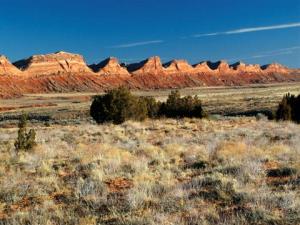
- The final picture shows the appearance from the west. I believe you can see why it was named COMB RIDGE.


I need to explain the very interesting geology of both the Four Aces claim and Happy Jack Mine. The floor of White Canyon is the highly fossiliferous Brushy Basin white limestone of the late Cretacious Morrison Formation. It creates a mile or more wide almost horizontal platform with narrow canyons eroded deep into this floor. The Moenkoepi Formation is widespread throughout the southwest USA. It is a red, brown to purple (particularly in White Canyon, Utah) 200 to 350 foot thick very fine grained sandstone which erodes into nearly vertical cliffs at the edges of the flat white platform. It was deposited in the early Triassic under a shallow sea some distance from shore ending about 240 million years ago. At that time the sea withdrew and the surface of the formation was dry land but almost level. Meandering streams, and tropical swamps developed with heavy cover of tree vegetation. After a geologically brief time the sea returned and Chinle shale began to be deposited far off shore reaching a depth of up to 1000 feet in our area.
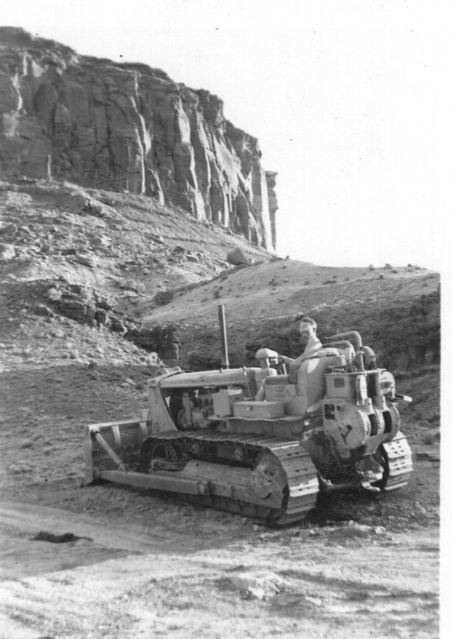
Theodore learning to operate a cat, in the evening, July, 1955. The cliff is Wingate Sandstone and it is named Copper Point because of the late 19th Century Four Aces copper mine just below it. The soft formation sloping up from the cat parking place to the Wingate is Chinle shale. It is the shale of the Painted Desert and the Petrified Forest National Parks. Note the cat built, switch back road up to the base of the Wingate.
As the sea began to return at the beginning of Chinle time, the shallow, meandering river channels filled in with coarse gravel, small rocks and lots of wood. This forms the discontinuous gray Shinarump Conglomerate Formation. At the top of the Moenkopi cliffs these filled stream beds appear as gray lens shaped outcrops about 50 to 90 feet deep and 100 to 250 feet wide. The very thick soft Chinle shale erodes into a not very steep slope gaining depth from its lower edge at the Moenkopi-Shinarump cliff top up to the bottom of the much taller bright red vertical cliffs of Wingate aeolean (wind deposited) sandstone.
At some point millions of years later when the previously named formations were buried under thousands of feet of over-burden, mineralized water was injected into the area. The very fine grained Moenkopi sandstone and Chinle shale were impervious, but the coarse grained Shinarump conglomerate was a good conduit for this water. There is controversy, but I think this probably happened when the volcanic Henry Mountains were erupted about 23 to 32 million years ago. (The geology of these mountain was intensively studied by John Wesley Powell and Grove Karl Gilbert who named the mountains after Joseph Henry of the Smithsonian and coined the term “laccolithic” to describe their formation. I have original copies of essentially all the early publications by these pioneer western American geologists who were at the forefront of worldwide geology in the late 19th Century.)
The substantial wood debris in the Shinarump adsorbed both copper and uranium, the two main minerals in the water. It is easy to spot the Shinarump as gray lens shaped outcrops cut into the top of the vertical Moenkoepi cliffs under the gradually sloping Chinle shale. Any prospector would find such outcrops interesting. Copper ore is also easy to see because it is brightly colored blue or green. Thus in the 1890s, prospectors identified most of the Shinarump outcrops as rich copper mines. Several were worked for a year or two yielding rich ore. However, the expense of getting the ore to smelters (via mule train to the Colorado River, one way raft to another mule train down river) destroyed any hope of profit, so none of the mines lasted long. Most of these mines had become a patented claim and thus remained legal properties forever. The Happy Jack Mine and the Four Aces Mine (about seven miles apart along White Canyon) were two of the copper mines which had substantial mine tunnels into the Shinarump. I believe both were worked mainly in 1893. The yellow uranium ore is also easily recognized, but before the 1940s the main use of uranium was to color glass purple, and a tiny amount supplied this small industry.

This picture is NOT near White Canyon but it shows the formations which are seen throughout the southwest including White Canyon. The Navajo sandstone at the top of this picture is all eroded away at Copper Point, but the very top of the point is Kayenta sandstone , while the main cliff is Wingate sandstone. The Chinle shale formation is much thicker at White Canyon. Except for being colored purple near Copper Point, the Moenkopi looks just the same.
The Tedesco brothers lived in Blanding. One was the town barber and the other ran the garage with a partner whose name I have forgotten. During World War II they bought the Happy Jack mine claim and re-opened the tunnel, mostly for fun and adventure but no doubt with hopes of eventual profit. At the end of the war they sent samples for copper assay. Fortunately the assayer was on his toes and said that the ore was definitely commercial for copper but that he suggested they mine it for uranium. By the time I met them in 1955 they were multimillionaires but still worked the mine themselves for fun. (I have a wonderful mining story about one of them for a bit later.)
Now the geological origin of the Happy Jack and Four Aces claims were identical and their 19th Century development was exactly parallel with similar very rich copper deposits. So our company geologist, my friend Richard V. Gaines, had every reason to assume that they would contain the same amount of uranium. Unfortunately it turned out that water had somehow gotten into our Four Aces Shinarump formation thousands (possibly millions) of years earlier. Uranium ore is more soluble than copper ore, so the uranium had been leached out leaving the copper largely behind. Since Exploration Incorporated was looking for ten million dollar mines, and after spending a bit over $100,000 a month we had found only a few million dollars of uranium, it sold the lease. Some other company mined out the Four Aces property so there was nothing left of what I remembered when I visited with my children years later.
With this preparation I will have more 1955 mining stories soon.

1955, August Theodore in front of main Four Aces mine tunnel in the Shinarump formation
In June 1955 I arrived by plane in Grand Junction, Colorado to work for Exploration Incorporated. My good friend Richard V. Gaines was their chief geologist and had gotten me the job. He drove me down to White Canyon and back so I would know the way. We went west from Grand Junction on busy US 50 towards Green River staying south of the Book Cliffs. In the middle of nowhere we turned south on US 191 through Moab, Monticello and Blanding. Then again in the middle of nowhere we turned west on Utah 95 over dramatic Comb Ridge and angled north past Fry Canyon (the last settlement with a permanent population of perhaps 10) into White Canyon. This highway was shown on highway maps with nothing to alert people to the fact that it was just two wheel tracks through sand and rock for most of its length completely impassable to any ordinary two wheel drive vehicle. In White Canyon, Dick pointed out the Happy Jack Mine and told me that the people there would provide help if I needed it.
To get up to Four Aces Claim one left US 95 in the absolute middle of nowhere and drove along an almost invisible track towards the sheer purple Moenkopi sandstone cliff. Finally you saw a narrow back-up switch back road up the Moenkopi and headed up with substantial doubt that it was possible to get to the top. After a sharp turn at the top (which I later widened on my own with dynamite) one wandered around on the gradually sloping, heavily eroded gaily-colored Chinle shale until arriving at the end of two tunnels driven into the Shinarump outcrop on top of the Moenkopi.
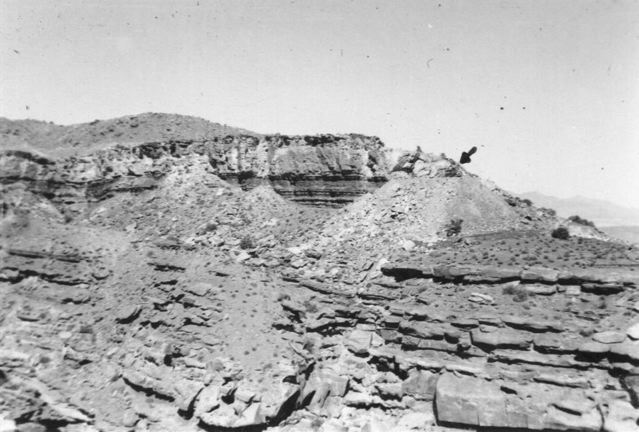
1955 View of Four Aces tunnel from about half a mile. Note the mine tailings from 1893 below. The light colored rock is Shinarump conglomerate, dark rock below is Moenkopi sandstone, sloping stuff piled on top is Chinle shale.
Dick drove me back to Grand Junction and the next day I started down alone to be the only one at the claim when a drilling crew arrived. It was a long drive and dusk when I passed Happy Jack Mine. I was afraid I might miss the minimal road in to the Four Aces Claim, so I bedded down beside the highway where it had been widened to allow a small plane to land.
I got up about 4:00 am and drove on finding the road to the mine without trouble and negotiating the difficult back-up switchback. I unpacked and made some breakfast. About 9:00 am I saw trucks pull into the road to the switchback 400 feet below and drove down.
It was quite a sight that met my eyes when I arrived. Jerry [[I have forgotten his name but this will do]] was a very small 45 year old man in worn clothes leaning on a rifle against the front of his pickup truck with two pistols stuck into his belt one on each side. Three guys (younger than me) were armed and trying to look as tough as possible and I think there was another guy perhaps in his late 30s not posing. I introduced myself and ascertained they were the drillers I was waiting for. I warned them about the difficulty of the switch back road and started to lead them up in my company jeep. Their brand new compressor truck followed me driven by one of the kids. Before we had gotten very far up it started to slide off the side of the road. It seemed to me that it could be driven right back on but all of them said they did not think so and that it was worth $40,000 (even that much was a LOT of money in the early 1950s) and that I needed to get something to pull it back on the road.
I immediately thought of the Happy Jack Mine about 7 miles up White Canyon. I had noted a new bulldozer by the mine as I drove by. My jeep was trapped up the narrow road from the compressor truck. They wanted me to drive one of their trucks to get help, but I was not sure I would know its gear pattern and declined. Eventually one of them drove me up to the Happy jack Mine. No one was above ground, but the lights and compressor were running so I knew someone must be underground. I took a hard hat and battery operated headlamp off the rack and started into the mine, not knowing who might be there or what they might be doing. Fortunately, before I had gone far, I saw someone rolling out an ore cart by hand towards me. I made sure that he had seen me and turned towards the entrance. When the 55 year old guy (I learned that he was one of the Tedesco brothers who owned the mine) came out, I introduced myself and said I was working at the Four Aces Claim and explained the difficulty I was in. This guy, who had never seen me before but knew my company was working the Four Aces claim, said I could borrow his brand new D-8 cat, but that I had to get a low boy to move it down to the bottom of our cliff. I asked how I could do that. He said I should go across Utah 95 to the AEC buying station that had been established right next to the Happy Jack Mine to buy their rich output. The people at the buying station had a radio and could call someone at Fry canyon who had a low boy.
I did as told and at the buying station folks who had never seen or heard of me called up the guy at Fry canyon who was in the same condition. I asked him if I could borrow his truck saying my company would pay for it. Without question he said he would come right up. In about an hour he appeared and I think the mine owner loaded his cat on the truck and we (the truck owner and I) headed down the road towards Four Aces followed by the drilling crew ruffians.
We arrived and the drillers announced that I was to pull their truck back on the road. I had never operated a caterpillar tractor at that time, but was reluctant to say so.
An amazing deus ex machina arrived exactly at this point. My older brother, Macdougall, was still working for Dick Gaines in Washington State, but when he learned I was coming out to Utah he got permission to drive down to see me. He showed up. After a more than usually friendly greeting I explained the situation and he skillfully pulled the air compressor truck onto the road. We got all the drillers up to where they were to set up and loaded the cat back onto the low boy. I think the truck owner must have taken the cat back to the Happy Jack Mine. Macdougall left and I cooked some supper and went to bed at 3:00 am. I recall charging the company for a 23 hour day and they paid me.
[[To the reader: This is the first of several blogs I will write about my father. I have chosen to start it at his 40th birthday and then go back about a dozen years. I will refer to him as “Palmer” for your benefit although I still call him “Daddy”, myself. His story is far from finished.]]
Although born in Leicester, England, Palmer had lived in Missouri since he was 3 years old and in the lead and zinc mining town of Webb City in south west Missouri since 1891 when he was 16.
In 1957, my father told me that on the evening of his fortieth birthday (April 8, 1915) he thought to himself, “If this is all there is to life, I wonder if it is worth it.”
This melancholy reflection was due to two main causes. First, since age 11 he had been the main support of his parents and older sister. Since his family put a high value on education he had attended as much school as possible, but much less than he wanted. Through initiative and hard work he had progressed from delivering heavy loads with his father’s team and wagon in his teenage years to being chief bookkeeper for a local oil company (which was destined to become a leading national company a few years later). But these jobs were in no way related to his real interests.
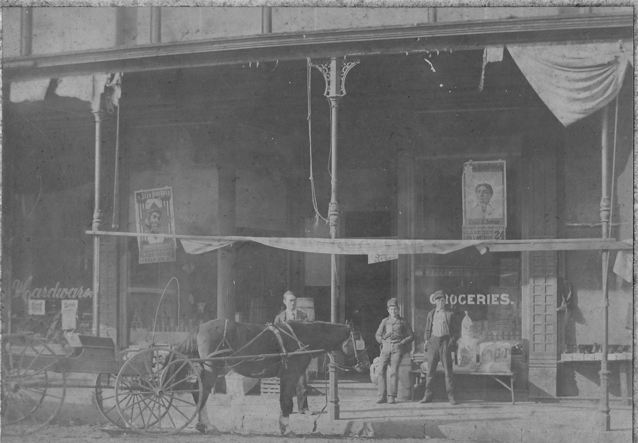
1895 Ernest Jesse Palmer standing behind his father's team of horses ready to deliver groceries in Webb City, Missouri
The proximate cause of his depression in 1915 was the First Word War. Palmer was an idealist all his life although deeply grounded in a detailed understanding of current social and political forces. Like many midwestern people of the period he had grown up in a Socialist family. He deeply believed in the Second (Socialist) International’s repeated prewar pledges (1891, 1896, 1900, 1907), that none of its members would engage in another “rich man’s war”. Instead, almost all the European Socialist parties decided to support this completely unnecessary war within weeks of its beginning in August, 1914. Palmer found theses decisions a source of great anguish and a fundamental blow to his idealism. The terrible destruction of the war was only beginning that evening in 1915, but he probably could foresee it.
In fact, in the light of day, Palmer’s life in 1915 was already well started on the road that would lead to a satisfying conclusion. From his earliest childhood he had been fascinated by all aspects of natural history. His parents encouraged this interest and were even able to buy him books on the subject, despite their borderline poverty.
In his rare free time, particularly on Sundays (at that time the six day work-week was still standard), he spent as much time as possible collecting minerals, fossils, modern shells, bird eggs, Indian artifacts, etc. In those days (long before radio or television) many people collected such things. There were several national magazines where he could post a three line advertisement for a few pennies saying that he had these kinds of specimens for sale. He soon had a following of satisfied customers. At the time, his main interest was the abundant Mississippian era marine fossils in the mine tailing piles. He began to know quite a bit about these fossils and to write to experts with questions. The experts depended on knowledgeable people like him to send them interesting specimens from out-of-the-way places. In return they sent him reference books and copies of their publications.
In 1900 his broad interest in natural history took on a new focus after he read the paper, A list of the trees, shrubs and vines of Missouri, by Benjamin Franklin Bush (December 21, 1858 to February 14, 1937). In the introduction, Bush requested “teachers, farmers and horticulturists to do all they can to further this [work] by corresponding with the undersigned, and sending twigs, leaves, flowers and fruit of every woody plant that they desire to learn the name of…” Palmer sent Bush his unknown plants and was urged to send more. Palmer’s lifelong warm friendship with Bush was cemented the following spring when Palmer began accompanying Bush “Whenever possible…as his eager assistant, guide and pupil.”
Through Bush, Palmer made his life-changing connection to the Arnold Arboretum and its founding Director Charles Sprague Sargent (April 24, 1841 to March 22, 1927) and, a bit later, to the Missouri Botanical Garden and its director William Trelease (February 22, 1857 to January 1, 1945). Bush was already sending specimens to both. Sargent had a particular interest in the genus Crataegus (hawthorns). There were many forms of this genus around Webb City which were generally considered new species at this time. Soon Sergeant discovered that Palmer was an even better collector than Bush, who was very good. This resulted in two remarkable visits to Webb City.
Hugo de Vries (February 16, 1848 to May 21, 1935) is the Dutch botanist who discovered mutations and re-discovered the fundamental laws of genetics (originally found by Mendel but unknown to Professor de Vries and the rest of the world at first). When de Vries visited the United States in 1904, he asked Sargent and Trelease for recommendations of where he could go to get the best introduction to the American flora. One of their suggestions was to visit Palmer when he was free to botanize. Professor de Vries did so, staying at the house Palmer and his father, Amos, had designed and built with their own hands in Webb City. And in 1907, Sargent, a man of great inherited wealth and accustomed to being waited on by a staff of liveried servants, also stayed at the house.
Eventually, Palmer was invited to publish on his natural history collections. December, 1910 marks the appearance in the Transactions of the Academy of Science of St. Louis (Vol. 19, No. 7) of Palmer’s first botanical work, Flora of the Grand Falls Chert Barrens.
This early work on botanical ecology records Palmer’s collection of plants in an area of bare rock near a stream. This peculiar area yielded a number of species not found elsewhere in the area—species which could survive in rigorous conditions of alternate very moist and very dry soil where the common local flora could not. Palmer describes the location, the geology, geological history and ecology of the area in great detail. He appends a list of 117 plants collected in the approximately two square mile area, collected as he modestly says, in “several hasty collecting trips at various times of the year, although scarcely covering the entire season.”

June 15, 1926: Ernest Jesse Palmer botanizing at Camp McGuire in the Davis Mountains of Texas. (He undoubtedly named the camp for the ranch foreman who gave him permission to camp there. The bundles are herbarium specimens of dried plants.)
Sources: Beginning quotation from EJP recounted to TWP when EJP was ready for an operation which the doctors said he might not survive. In fact, he lived five more years. Quotations about B. F. Bush are from Palmer’s beautiful obituary: Benjamin Franklin Bush, The American Midland Naturalist, Vol. 18, No. 3, pp. i – vi, May, 1937.
Historical Prologue
Summitville Mine was started about 1870 and worked for several decades by many different small gold mining companies. At some time (my best guess is the 1920s or early 1930s) all the mines were consolidated into one huge enterprise. (Everything I say about the period before 1955 is based on my memory of the abundant physical evidence I could see, the many old mining records I consulted in the engineering office that summer and the then 20-year old memories preserved by Leadville miners I got to know. The overall picture is surely correct but dates and numbers are no more than educated guesses.) In the mid-1930s about 1,000 miners were working eight different levels in South Mountain with the 3,500 foot long Reynolds Tunnel at 11,400 feet above sea level giving access to the lowest level. (By 1955 this tunnel was used as the prime example in several textbooks on mining.) There were essentially no shafts in the mine, and ore was removed from stopes alongside the main tunnels. The Reynolds tunnel was completely straight with a 2% grade for drainage except that about 400 feet from the entrance it passed through about 40 feet of very unstable rock and a U-shaped offset had been built there. The miners had lived in three huge dormitory buildings of which we reopened one and number of cabins built on company land. Right next to our dormitory the main engine room housed three gigantic diesel air pumps each capable of supplying compressed air to hundreds of pneumatic Jack-hammer wielding miners.
The ore was gold, silver, copper and other metals as sulphide ore. When mining exposes sulphide ore to oxygen from the air, oxidation creates sulphuric acid. Like most mines, Summitville makes enough water to wash out and dilute the acid quickly. However the tiny steel rail (about 25 pounds per yard) used to roll ore carts out of a mine is corroded by even this dilute acid pretty quickly. The rich ore at Summitville makes enough acid to compromise rails in only a few months.
[[This really is related!]] By 1944 the US was clearly winning World War II in Europe but shifting the effort to the Pacific required a huge increase in ship building and thus a much increased need for steel. The government removed the priority for steel rails from precious metal mines. Since the rails at Summitville corroded in a matter of weeks the enormous mining operation had to be shut down quickly. The substantial infrastructure was surprisingly well moth-balled.
In 1955 Research Incorporated (successor of Exploration Incorporated) which employed me bought the lease and sent a small crew (described in my earlier story) to reopen the mine. At that time any gold mined in the US had to be sold to the government at the ridiculously low price of $35 a Troy ounce. It was widely understood that the real value of gold was about $350 per ounce. Thus no mining company removed gold unless it was part of ore with great value in other metals. We were not there to mine gold but to prove how large the reserves were.
After re-opening and repairing the Reynolds tunnel, our miners used their savvy to core drill in directions where they hoped to find rich gold deposits. They quickly proved millions of dollars worth of reserves even at $35. It was believed in 1955 that the US could not sustain the $35 dollar price for much longer. In fact it lasted for more than 20 years. So by the end of the summer the company was sitting on a future bonanza of enormous proportions.
The Actual Story (which needed some of this background.)
One morning all twelve miners were working deep in the Reynolds tunnel, when the gigantic air pump suddenly speeded up because of the loss of back pressure. Air started rushing out of the Reynolds adit with a mighty roar and force enough to pick up stones the size of a walnut. The company had allowed three young childless wives to live with their husbands in our huge dorm. They instantly descended on me in the first stages of hysteria. Any woman who marries a miner knows that there is a nontrivial chance that her man will die underground.
It took about 4 hours to drive a four wheel drive jeep to the nearest town. Sometimes I had a radio telephone but Dirk had taken it with him that day. I tried to soothe the wives, but I was really pretty scared myself. As the mining engineer I was legally responsible the safety of our operation.
My first question was whether I should turn of the air compressor. I decided not to do so because it seemed most likely that a new cave-in had occurred at the unstable section of the tunnel. If the men were trapped behind an impenetrable cave-in, conceivably the pump was delivering them some air. So I put on a hard hat with a fresh lamp and started into the maelstrom issuing from the adit (tunnel entrance).
To my ENORMOUS relief, before I had gotten far in, I met the men walking out and laughing. The 10 inch diameter steel pipe that carried compressed air into the mine had simply come apart.
I felt at the time, and still feel, that I handled this scary situation as well as I could have. (Afterwards I did realize that it would have been better to turn off the compressor. With it running I could not have heard anything inside the mine and my visibility was minimal with dust and small rock rushing towards me.) However, I knew then and for the rest of the summer, that if something really serious happened, my ability to rescue the miners was minimal.
In 1984 a predatory company, Galactic Resources, in no way related to the company for which I had worked, bought the lease, ground up much of South Mountain (which held all the mine tunnels), and created a 300 foot tall leach stack which they sprayed with sodium cyanide solution to extract the gold. After recovering about 11 TONS of gold they abandoned the whole operation in 1992 which became the absolutely worst Super Fund Site in the US. I have never been back but Google Earth and other web sites show the horrible mess they left behind. (About 9 TONS of pure gold had been recovered from 1870 through 1944.)
In the summer of 1956 thirteen men were living in a huge old building at the entrance to the Reynolds Tunnel, reopening the Summitville gold mine deep in the San Juan Mountains. I was the mining engineer, required by Colorado law, on my second college summer vacation working as a prospector. Ray (about 40) was the head miner in day-to-day charge of eleven other Leadville hard-rock miners he had hired. I think he had attended some high school, and he was very smart, a good leader and admired for his knowledge of mining and good sense by me and the rest of the crew.
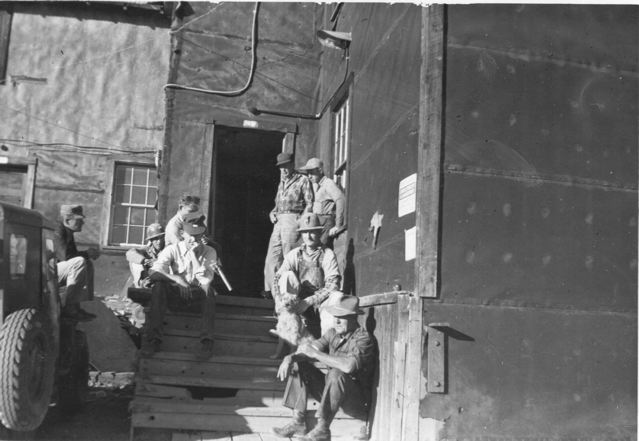 The picture to the right shows some of the Summitville miners in front of our building. Ray is the short man with a light cap standing in front of the window. Schmitte sits at the bottom of the steps. (The guy sitting on the Jeep is a company man visiting for the day. Dirk not present.)
Late in the summer the company home office decided we needed a geologist and sent us Dirk, the fearless. He was from Holland with a PhD and about a decade of field experience in North Africa. As I showed him around he drove our Jeep across landslides which I was sure would send us down to oblivion. He had never seen an American mountain lion, so when we discovered an occupied den he shot down it with his 22 caliber pistol to summon the beast from the vasty deep while I put some distance between the den and myself. Fortunately, Hot Spur’s question was answered in the negative. [See Henry IV, Part 1, Act 3, Scene 1.]
One Sunday Dirk decided to go fishing. He was told of a great place across a pass from our home. So I took him up to the pass and showed him the large quaking bog at the top. When we walked out to the middle on apparently solid ground and I began to jump up and down, waves spread out marking the edge pretty clearly. After warning him to avoid the area on his way home, he drove the jeep to the fishing stream and I turned back home. The fishing was so good that Dirk did not start back until it was getting dark. Recall that he was fearless; so he thought Theodore is too cautious so I will take the direct route over this perfectly flat area. About 200 feet in the jeep broke through the surface. Dirk rescued his trout and walked back to a good supper. The company had equipped these jeeps with lots of special equipment so we knew we had to retrieve it, but we could do nothing at night. After breakfast all 14 of us gathered equipment that we thought might be useful and went up to the edge of the bog in the other jeeps. Fortunately the front bumper of the jeep had caught on a big piece of wood, so we quickly attached a long cable and secured it to a large tree growing at the edge of the bog.
Now this is the interesting part. We three boss-men discussed how to retrieve the jeep for about half an hour, without coming up with a viable plan. Only THEN did the youngest miner in the group speak-up. He had left Leadville for Oregon and spent a few years as a logger. (Both occupations are dangerous, but on the average loggers live longer.) He knew just what to do but also knew that he had to wait to tell us big guys. We quickly cut down an 80 foot tall tree and used a jeep on solid ground to move its butt against the tree at the edge of the bog. A jeep at the far end could pull the top of the tree about 50 feet with great force. So we attached the cable about 1/3 of the way from our fulcrum and put three hand cranked come-alongs into the cable connection. As the jeep on land drove forward, the jeep in the lake moved towards shore. As the jeep on land backed up, we furiously took up as much slack as possible with the come-alongs while others tried to keep the jeep in the water from sinking or moving back.
By mid afternoon we had our jeep back and by mutual agreement took the rest of the day off with praise for our young hero and a few snide remarks about Dirk. You ask, did he learn caution? The summer was almost over, but I saw no indication that he did.
I HATE war!
My father was a pacifist all his life until he read Hitler’s “Mein Kampf”. After that he wrote to all the national newspaper’s and magazines to which he often sent political and social comments saying “I have been a life-long pacifist, but Hitler is different and the United States must build its capacity for an inevitable war with him.”
Since the Second World War was the most overwhelming experience of my childhood, I have never been a pacifist, but I hate war with an overwhelming passion.
War destroys all those involved with it, not just those killed and physically maimed. I have no idea what we will learn about the staff sergeant who perpetrated the horrible atrocity in Afghanistan, but he and the men who urinated on the corpses of dead human beings and thousands of others have been stripped of their humanity by war. Many will struggle and succeed in controlling their rage and horror within themselves for a lifetime embittered by their youthful degradation by war. But I fear we will see copy-cat atrocities.
I honor those who choose to serve their country in the military and I know that many generals and military leaders understand the horror of war. Somehow, we must convince all governments that war is almost always at best a temporary solution which will create worse problems in the long run. All my life I have supported the idea of an inescapable draft (with suitable service for those who cannot, in good conscience, serve in the military), so that everyone would be forced to think of the horrors of war for their own family.
PLEASE let us not go to war in Syria or Iran! I hope we can somehow convince Israel not to start a war with Iran. I fully and deeply understand Israel’s fear of nuclear annihilation by Iran, but war will likely only postpone and make more certain a confrontation. The tragic consequences of a long period of war psychology is all too obvious in Israel and in my own beloved United Sates.
Anything short of giving up civilization is always preferable to war!
Once the website is fully constructed, there may be blog posts from time to time. Stay tuned.
In the meantime, please click on the links above.
 Theodore W. Palmer